






If you run a salon, you already know the real struggle. The phone rings while you are washing out hair color. A walk-in client arrives when you are already running late. Messages keep coming on Instagram, clients ask about availability and then disappear. A no-show on a busy evening leaves an empty chair that should have covered your weekly product cost. Most salon owners do not lose revenue because they lack skill. They lose it because their marketing is not structured.
Every empty hour hurts your bottom line. A single unfilled slot each day can quietly cost hundreds over a month. This does not happen because clients are not interested. It happens because the marketing journey breaks down. Clients cannot find clear information. They do not see enough proof and get confused between platforms, and they hesitate and choose a salon that feels easier and more reliable.
Essential Salon Marketing Skills for 2026
Salon marketing in 2026 is not about random posts or occasional discounts. It is about building a connected system that attracts the right clients, builds trust before the first visit, and removes friction at the moment of decision. When these pieces work together, booking becomes the natural outcome rather than a daily struggle.
This guide focuses on practical skills that successful salons consistently use:
- Showing up locally when clients search for a salon
- Presenting services clearly with strong proof and visuals
- Using content and social signals to influence decisions
- Running targeted campaigns that reach ready-to-book clients
- Measuring what works and improving it over time
Each strategy in this guide is designed to be clear, measurable, and directly tied to revenue, not vanity metrics or short-term tactics.
Proven Salon Marketing Strategies That Drive Growth
The strategies below focus on how successful salons attract attention, convert interest into bookings, and build long-term loyalty. Each one addresses a specific part of the client journey, from discovery to repeat visits, and works best when applied together rather than in isolation.
1. Win Local Search with SEO and Google Business
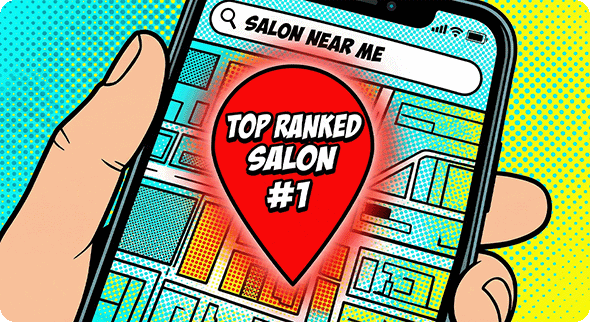
Most new salon clients begin with a local search. Phrases like hair salon near me or nail salon in my area signal immediate intent. Google consumer behavior data shows that over 75 percent of people who search for a local service take an action such as calling or visiting within 24 hours, which makes local search one of the most valuable marketing moments for salons.
Local SEO helps your salon appear clearly during this decision stage. Instead of chasing large traffic volumes, it focuses on relevance and proximity so nearby clients can find, evaluate, and choose you quickly. Research from Think with Google indicates that local intent searches convert significantly faster than general discovery searches, reinforcing why visibility at this stage matters.
Why local SEO is a core salon marketing strategy
Local SEO works because it mirrors how clients choose personal service businesses. According to BrightLocal’s consumer research, nearly 9 out of 10 consumers read online reviews before selecting a local business. For salons, this means visibility must be paired with trust signals.
Local SEO supports this by clearly communicating:
- Where your salon is located
- What services you offer
- That other clients have had positive experiences
When these signals are present, clients move from comparison to booking with less hesitation.
Google Business Profile as your most valuable local marketing asset
Your Google Business Profile is often the first and last touchpoint before a booking decision. Google Business Profile insights show that businesses with complete profiles receive several times more calls, direction requests, and website actions than incomplete listings.
High-performing salons keep this profile active by focusing on:
- Accurate service categories that match how clients search
- Real photos of work, staff, and the salon space
- Updated hours and contact information
- Regular responses to recent reviews
This clarity reduces uncertainty and increases engagement.
How consistency and local signals influence client trust
Consistency builds confidence. Your salon name, address, and phone number should match across your website, social platforms, and local directories. Studies referenced by Moz show that inconsistent local information can weaken trust and reduce visibility in map-based results.
Local SEO is not about attracting more visitors. It is about being visible and credible at the exact moment a client decides. When trust is established early, every other marketing strategy performs better.
2. Turn Your Salon Website into a Booking Magnet
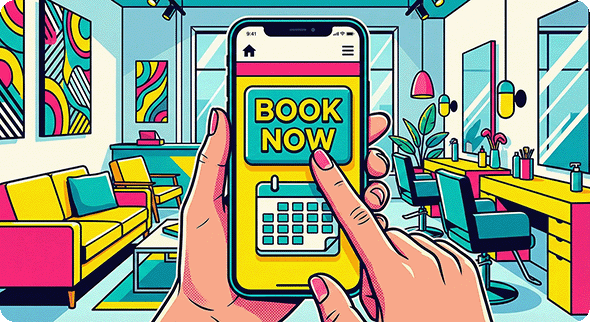
Most salon websites still act like online brochures. They list services, show a few photos, and ask clients to call or message. That gap between interest and action costs real bookings. Industry surveys from HubSpot indicate that over 70 percent of consumers prefer to book services online rather than call, and mobile users expect this to work instantly. When a website slows down, clients leave and choose a salon that feels easier.
A high-performing salon website is part of your marketing funnel. It supports local SEO, paid ads, social traffic, and referrals by answering questions quickly and guiding visitors to a clear next step. The goal is not to impress. The goal is to convert interest into confirmed appointments.
Why your website is a critical salon marketing channel
Your website is often the first place clients go after finding you on Maps or social media. Research from Google shows that users form trust judgments about a business website within seconds, especially for personal services. If information is unclear or outdated, confidence drops.
A strong website helps clients:
- Understand your services without confusion
- See proof of your work and experience
- Confirm pricing expectations or starting ranges
- Find availability without back-and-forth messages
When these elements are clear, booking feels natural.
What clients expect to see before they decide to book
Clients are not reading long pages, they scan. According to UX Planet, most users read only read 20 to 28% of a webpage. This means your website must communicate value quickly.
High-converting salon websites typically include:
- Clear service descriptions written in simple language
- Visual proof such as haircut galleries, before-and-after images, or short videos
- Customer reviews or testimonials near services
- A visible booking path on every important page
This reduces hesitation and shortens decision time.
How friction on your website costs you real bookings
Every extra step creates drop-off. Contact forms, unclear pricing, slow mobile pages, or hidden booking buttons all increase abandonment. Statista reports that more than 60 percent of local service traffic now comes from mobile devices, which makes simplicity critical.
A website that removes friction does not just look better. It converts better. When visitors can understand, trust, and act within a few clicks, marketing efforts across all channels become more effective.
3. Make Booking Effortless with Automation
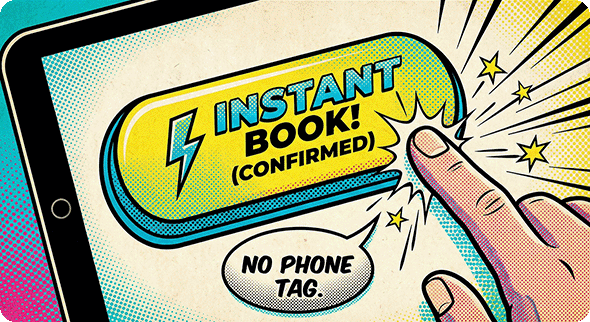
Marketing creates interest, but bookings create revenue. Many salons invest in SEO, social content, and ads, yet still lose clients at the final step. The reason is friction. Calls go unanswered, messages wait for replies, and confirmations take too long. According to Harvard Business Review, businesses that respond to leads within the first hour are nearly 7 times more likely to convert than those that respond later. In salons, even a short delay can mean a lost appointment.
Booking automation fixes this gap by turning attention into action. It ensures that when a client is ready, the system is ready too. This makes every marketing channel more effective without increasing workload.
Why booking friction is a hidden marketing problem
Clients expect speed and certainty. Research from Salesforce’s State of the Connected Customer shows that 80 percent of customers say the experience a business provides is as important as its services. When booking feels slow or unclear, trust drops.
Common friction points include:
- Waiting for replies to availability questions
- Manual confirmations that take hours
- Confusion around cancellations or rescheduling
- Missed calls during busy salon hours
Each one reduces conversion, even when demand exists.
How Automation Increases Conversions
Automation supports marketing by removing delays and uncertainty. When booking is instant and reliable, interest does not fade. Data from GetApp’s Appointment Scheduling Report shows that salons using online booking experience significantly higher completion rates compared to manual methods.
Automation helps by providing:
- Immediate booking confirmation
- Automated reminders before appointments
- Easy rescheduling without phone calls
- Clear policies presented upfront
This consistency increases confidence and follow-through.
Reducing No-Shows with Structured Booking Rules
No shows are one of the most expensive hidden costs in salons. According to Square’s Appointment Data, automated reminders can reduce no-show rates by up to 30 percent. Deposits and clear cancellation rules further protect revenue.
| Booking approach | Impact on marketing results |
| Manual confirmations | Higher drop-off and no-show risk |
| Automated reminders | Improved attendance and trust |
| Clear booking rules | Better-qualified clients |
| Instant confirmations | Higher conversion from ads and SEO |
When fewer appointments fall through, marketing ROI increases automatically.
Booking automation is not an operational upgrade. It is a conversion strategy. When clients can book easily and confidently, every marketing effort works harder.
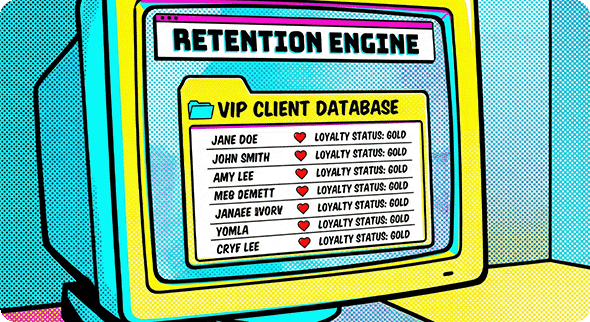
4. Build a Client Database That Drives Retention and Repeat Bookings
Most salon owners spend a lot of energy chasing new clients, then lose revenue quietly when past clients fade out, retention fixes that. Bain and Company has long cited that increasing retention by just 5 percent can increase profits by 25 percent to 95 percent, which is why a first-party client database is not just admin. It is a marketing asset that makes growth cheaper and more predictable.
A first-party database simply means client information you own and can use. It helps you stop guessing and start making repeat bookings easier.
Why first-party client data matters more than followers
Social reach is rented, your client list is owned. When algorithms change, your visibility drops. When you own client data, you can reconnect anytime and on your terms.
First-party data supports:
- Higher retention without constant discounts
- Faster reactivation when bookings slow down
- More relevant promotions based on real visit history
What information successful salons actually track
You do not need a complex system to start. The goal is to collect information that directly improves marketing relevance.
Track:
- Service history and last visit date
- Preferred staff member
- Visit frequency patterns
- Notes that affect service choices such as hair type or style preference
This makes your marketing feel personal instead of noisy.
How client data improves retention and lifetime value
When you know who is overdue, what they usually book, and when they typically return, your marketing becomes simple. You are not blasting messages. You are sending the right reminder at the right time. That creates trust and repeat behavior.
Use your database to:
- Identify clients who have not visited in 60 to 120 days
- Segment by service type so offers match real interests
- Plan retention campaigns inside your quarterly marketing plan
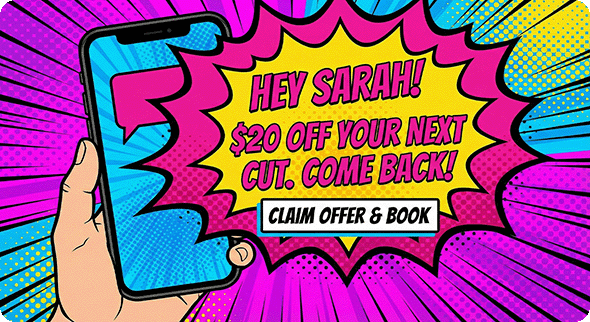
5. Turn One-Time Visitors into Regulars with Personalized Email and SMS
Most salon revenue does not come from first visits. It comes from repeat appointments. Personalized email and SMS work because they reach clients directly and feel familiar, not promotional. According to HubSpot, email remains one of the highest ROI marketing channels, generating strong returns when messages are timely and relevant. For appointment based businesses, SMS open rates regularly exceed 90 percent, which makes it especially powerful for reminders and follow ups.
Personalized communication helps salons stay visible without depending on social algorithms or paid ads. The goal is not to send more messages. It is to send better ones.
Why generic messages fail in salon marketing
Clients quickly ignore messages that feel irrelevant. Research from Salesforce shows that customers are far more likely to engage with brands that understand their preferences and past behavior.
Generic messaging leads to:
- Lower open and click rates
- Higher unsubscribe rates
- Reduced trust over time
Personalized messages feel like service, not marketing.
What personalized salon messaging actually looks like
Effective personalization is based on timing and context, not discounts. Messages should relate to what the client already does.
Common examples include:
- Reminders when a client is due for their next visit
- Follow ups with care tips after a service
- Notifications about availability for a service they usually book
- Gentle rebooking prompts instead of promotions
According to Campaign Monitor, personalized email campaigns can deliver significantly higher engagement compared to non-personalized messages.
How retention messaging increases lifetime value without discounts
Retention messaging works because it builds habits. Clients return because the process feels easy and familiar. Studies cited by Bain and Company show that returning customers spend more over time and are less price sensitive than new clients.
When messaging supports routine behavior rather than promotions, revenue becomes more predictable and marketing costs drop.
Personalized email and SMS are not about selling. They are about staying relevant and helpful between visits. When done well, they quietly power long term salon growth.
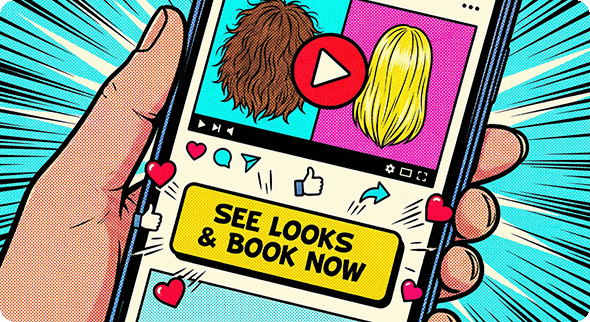
6. Use Social and Video Content to Influence Booking Decisions
Most clients check social media before booking a salon. They are not looking for captions or trends. They are looking for proof. Short videos and visual content help clients decide faster because they can see real results, real people, and real experiences. Meta has shared that short form video drives higher engagement for beauty and local service categories, while TikTok reports that users often discover new local businesses through video content before searching them on Google.
Social and video content work best when they support the decision stage of the client journey. They should reduce doubt and answer unspoken questions before a client reaches your website or booking page.
Why social media works best as a trust and validation channel
Clients use social platforms to validate what they already found through search or word of mouth. They want to confirm that your work is consistent and that your salon feels professional and welcoming.
Social content helps communicate:
- The quality of your results
- Your hygiene and professionalism
- The atmosphere inside your salon
- The personality of your team
What types of content actually drive salon bookings
Not all content converts. High-performing salons focus on content that shows outcomes, not promotions.
The most effective formats include:
- Before and after transformations
- Short educational clips about hair, skin, or nail care
- Behind-the-scenes moments that show process and care
- Quick client reactions or testimonials
Instagram and TikTok data consistently show that transformation based content increases saves and profile visits, which are strong indicators of booking intent.
How video content shortens the decision making process
Video answers questions faster than text. It shows skill, builds confidence, and reduces back and forth messages. Google research on video behavior shows that people are more likely to take action after watching short, relevant videos compared to reading long descriptions.
When social content builds trust early, booking becomes a natural next step. Social media does not replace other marketing strategies. It strengthens them by helping clients feel confident before they choose.
7. Build Trust with Local Influencers and Word of Mouth Marketing
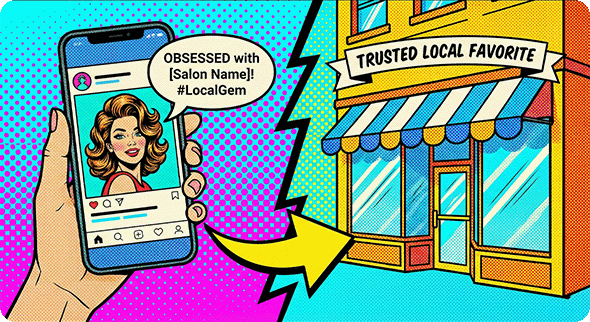
For salons, trust spreads fastest through people, not ads. Local influencers and word of mouth work because they feel personal and relevant. Clients are far more likely to act on recommendations from people they recognize or follow locally. Research from Nielsen shows that over 90 percent of consumers trust recommendations from people they know, and this trust often extends to local creators whose audiences share the same city or neighborhood.
Local influence marketing works best when it feels natural. It is not about celebrity endorsements. It is about showing real experiences through familiar faces that potential clients already trust.
Why local influence outperforms broad influencer campaigns
Large influencers may bring views, but local creators bring relevance. Their audience lives nearby, understands the area, and is more likely to book.
Local influencer content helps salons:
- Reach clients within a realistic travel distance
- Build credibility faster than paid ads
- Feel familiar instead of promotional
According to Influencer Marketing Hub, micro influencers often generate higher engagement rates than larger accounts, especially for local businesses.
How salons can collaborate without large budgets
Effective collaborations do not always require cash payments. Many salons work with local creators through experience based partnerships.
Common approaches include:
- Complimentary services in exchange for honest content
- Long term relationships instead of one off posts
- Inviting multiple local creators together to spark conversation
These collaborations often trigger organic word of mouth when creators talk to each other and their followers.
Turning influencer content into ongoing word of mouth
The real value comes after the post. Reusing influencer content across your own channels extends its impact.
Use this content to:
- Support social proof on your website
- Reinforce trust on social profiles
- Validate paid campaigns and promotions
Data from Wharton School research shows that referred customers often have higher lifetime value than non referred ones, making word of mouth one of the most sustainable growth drivers.
Local influencers and word of mouth do not replace your marketing system. They strengthen it by accelerating trust and reducing hesitation before booking.
8. Turn Reviews into a Consistent Client Acquisition Channel
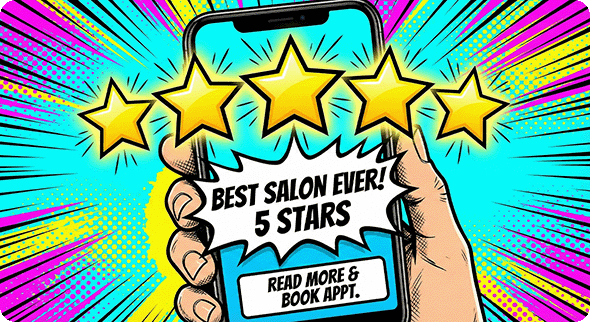
For most clients, reviews are the final checkpoint before booking a salon. They may discover you through search, social media, or word of mouth, but reviews often determine the decision. BrightLocal’s consumer research shows that over 85 percent of people trust online reviews as much as personal recommendations, especially for local service businesses like salons.
Reviews reduce uncertainty. They answer questions clients rarely ask directly, such as whether the salon is clean, whether staff are professional, and whether results match expectations. When reviews are visible and recent, clients feel safer choosing you.
Why reviews influence salon choice more than promotions
Salon services are personal. Clients are trusting you with their appearance and time. According to Podium’s local business research, businesses with strong review profiles see significantly higher conversion rates than those with few or outdated reviews.
Reviews work because they provide:
- Social proof from real people
- Emotional reassurance before booking
- Validation of skill and service quality
Discounts may attract attention, but reviews close the decision.
Where reviews matter most in the client journey
Not all review placements are equal. Clients usually encounter reviews in moments of comparison.
The most influential locations include:
- Google Maps and local search results
- Your Google Business Profile
- Service pages on your website
- Social profiles during final checks
Google data has shown that businesses with higher ratings and more recent reviews receive more clicks and actions from local search results.
How to encourage reviews without feeling pushy
The best time to request a review is when the experience is fresh. Clients are more willing to respond when the request feels easy and well timed.
Effective approaches include:
- Asking shortly after the appointment
- Sharing a direct review link
- Keeping the request simple and optional
According to ReviewTrackers, timely review requests significantly increase response rates compared to delayed follow ups.
Reviews are not just feedback. They are a long term acquisition channel. When managed consistently, they lower marketing friction and help clients choose your salon with confidence.
9. Capture High-Intent Clients with Paid Ads
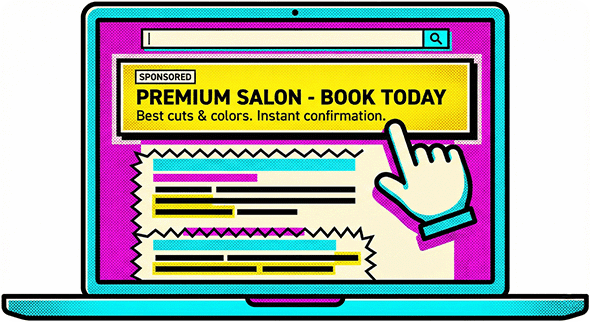
Organic marketing builds long-term visibility, but paid ads capture demand when clients are ready to act. For salons, this matters most during high-intent moments like searching for a nearby service or comparing options quickly. Google data shows that local service ads and search ads often drive stronger conversion rates than general display campaigns, especially for appointment-based businesses.
Paid ads work best when they are used to fill real gaps. They help promote new services, support new staff availability, and smooth out slow periods without waiting for organic growth to catch up.
Why paid ads work best at the decision stage
Paid ads succeed when intent is already present. Unlike awareness campaigns, salon ads perform best when they appear at the moment a client is actively searching.
Paid ads support decision making by:
- Appearing during “near me” and service-based searches
- Reinforcing trust built through reviews and social proof
- Offering clear next steps instead of vague brand messages
According to Google’s local advertising benchmarks, local search ads often outperform social ads in direct response scenarios for service businesses.
Which paid channels matter most for salons
Not every platform fits salon marketing equally. Location and intent should guide where you invest.
The most effective channels typically include:
- Google Search Ads for service-specific and local queries
- Local Service Ads for map visibility and call-driven bookings
- Instagram and Facebook ads for visual proof and retargeting
How to align ads with booking intent
Paid ads fail when they send users to generic pages. Clients expect relevance and speed. Research from Unbounce shows that landing pages matched to ad intent convert significantly better than homepages.
Effective salon ads guide clients to:
- A specific service or offer
- Clear pricing expectations
- Immediate booking options
Paid ads are not meant to replace organic strategies. They amplify what already works and turn intent into immediate bookings when timing matters most.
10. Plan Quarterly Marketing Using Real Salon Data
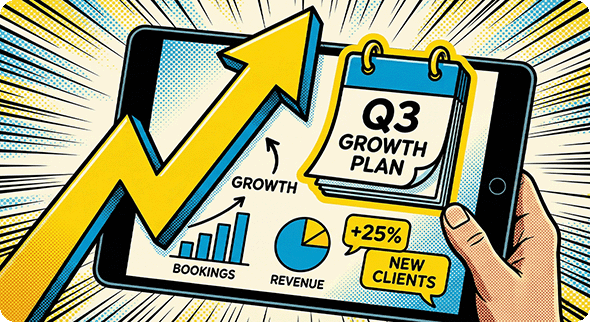
Many salon owners jump from one tactic to another without a clear rhythm. One month focuses on Instagram, the next on discounts, then nothing sticks. Quarterly planning solves this by creating focus without locking you into a rigid annual plan. Research shared by CoSchedule shows that marketers who document and plan campaigns are significantly more likely to report success than those who act reactively.
Quarterly planning works well for salons because demand shifts with seasons, staff availability, and service trends. A shorter planning window makes it easier to adjust while staying consistent.
Why quarterly planning works better than yearly plans for salons
Annual plans often fail because salon realities change quickly. Staff schedules shift. Certain services trend unexpectedly. Local demand fluctuates.
Quarterly planning helps salons:
- Focus on a small set of realistic goals
- Measure results before doubling down
- Adjust strategies without losing momentum
Harvard Business Review notes that shorter planning cycles improve execution and accountability, especially for small teams managing multiple responsibilities.
Which metrics actually matter when planning salon marketing
Not all data deserves equal attention. Successful salons track metrics that reflect real business outcomes, not vanity numbers.
The most useful metrics include:
- New versus returning clients
- Most-booked services
- Peak and low-demand periods
- No-show and cancellation rates
According to Gartner research, data-driven decision making improves performance outcomes, particularly when teams focus on a limited number of relevant metrics.
Using data to decide where to invest your marketing effort
When data guides planning, marketing becomes more efficient. You can promote services that already perform well, invest in channels that convert, and stop spending on tactics that look good but do not drive bookings.
Data helps you:
- Allocate budget more effectively
- Identify opportunities for growth
- Improve consistency across campaigns
Quarterly planning turns marketing into a repeatable system rather than a series of experiments. When decisions are based on real numbers, growth becomes more predictable.
11. Build Local Visibility Through Events and Partnerships
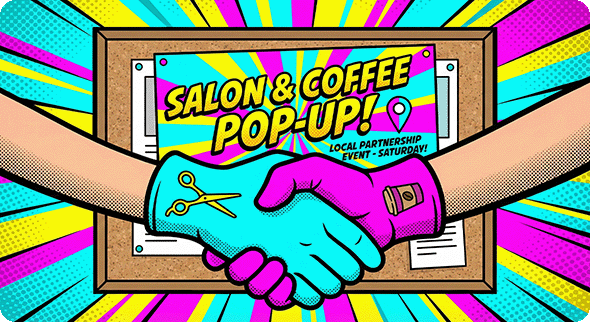
Digital marketing drives discovery, but in-person experiences build deeper trust. Local events and partnerships help salons move beyond being just another option on a map and become a recognizable part of the community. According to the Event Marketing Institute, more than 80 percent of consumers say they trust brands more after attending a live event, especially when the experience feels educational or interactive.
For salons, events and partnerships work because they combine visibility with personal connection. Clients are not just seeing your work online. They are experiencing your expertise in real time.
Why community-based marketing works for salons
Salons are inherently local businesses. When you show up where your clients already spend time, trust builds faster. Community-focused marketing reduces the distance between first interaction and first booking.
Community visibility helps salons:
- Reach people who live nearby
- Build familiarity without heavy advertising
- Create word of mouth naturally
Research from Nielsen shows that people are more likely to trust and remember brands that participate in local activities compared to those that rely only on ads.
What types of events and partnerships make sense
Events do not need to be large or expensive to be effective. Small, focused experiences often perform better.
Common examples include:
- Hair or skincare workshops hosted at the salon
- Collaborations with gyms, yoga studios, or boutiques
- Pop-up services at local markets or fairs
- Joint promotions with nearby businesses
These formats position your salon as helpful and approachable rather than sales-driven.
How events turn visibility into future bookings
The goal of events is not immediate sales. It is relationship building. According to data shared by Bizzabo, event attendees are significantly more likely to engage with a brand after the experience, especially when follow-up is thoughtful.
Successful salons use events to:
- Collect contact details for follow-up
- Encourage trial of services
- Create content and reviews afterward
Events and partnerships strengthen your marketing ecosystem by adding a human layer that digital channels alone cannot replace.
12. Build a Salon Brand Clients Trust Instantly
When clients compare salons, they rarely analyze details deeply. Most decisions are emotional and fast. Brand perception fills the gap between interest and action. Your brand is not just your logo or colors. It is how professional, consistent, and trustworthy your salon feels at every touchpoint. Research from Lucidpress shows that consistent brand presentation can increase revenue by more than 20 percent, especially for service-based businesses.
Branding matters even more for salons because services are personal. Clients are choosing an experience, not a product. A clear and confident brand helps them feel comfortable booking without hesitation.
Why branding influences booking decisions more than pricing
Price attracts attention, but brand builds confidence. According to Edelman’s Trust Barometer, consumers are more likely to choose brands they recognize and trust, even when cheaper options exist.
A strong salon brand helps communicate:
- Professionalism and reliability
- Consistency across services and staff
- The experience clients can expect
When brand signals are clear, clients focus less on price and more on fit.
What makes a salon brand feel trustworthy
Trust is built through repetition and alignment. Every place a client encounters your salon should feel familiar.
Key elements include:
- Consistent visuals across website, social, and in-salon materials
- Real photos of your team and space
- A clear tone in how you communicate online and offline
According to Stanford research on credibility, visual consistency strongly influences perceived trustworthiness, especially for first-time visitors.
How brand consistency supports long-term growth
Strong branding compounds over time. It makes reviews more believable, ads more effective, and referrals easier. Clients remember you, recommend you, and return without re-evaluating options each time.
Branding is not a one-time task. It is an ongoing marketing asset that supports every strategy in this guide.
Salon Growth Blueprint for 2026
Salons that grow consistently in 2026 do not rely on one winning tactic. They build a connected system. They focus on being easy to find locally, clear to understand online, and simple to book. Instead of chasing every new trend, they align a few core strategies and repeat them quarter after quarter. This reduces chaos, improves cash flow, and makes marketing more predictable.
At a high level, successful salon owners follow this blueprint:
- Attract demand through local search, content, reviews, and paid ads
- Convert interest into bookings with a clear website and simple booking flow
- Retain clients using data, automation, and personalized communication
- Review performance quarterly and improve what already works
When these pieces work together, growth feels controlled instead of overwhelming.
Conclusion
Salon marketing in 2026 is not about doing more. It is about doing the right things in the right order. Visibility alone does not create growth. Posting daily or running random promotions does not either. What drives results is a structured system that helps clients find your salon, understand your services, and book without friction.
The strategies in this guide are designed to work together. Local SEO brings intent. Your website and booking flow convert it. Automation protects your time. Data and planning keep your marketing focused. Content, reviews, influencers, and ads build trust over time.
With the right structure in place and support from a modern booking and appointment management system like Salonly, salon growth becomes something you can plan for, measure, and repeat year after year.
Frequently Asked Questions About Salon Marketing
The most effective strategies focus on local visibility, clear online presence, easy booking, strong reviews, and consistent communication. Salons that combine local SEO, content, automation, and data-driven planning see more predictable growth than those relying on single tactics.
To attract more clients, make sure your salon appears in local search results, clearly explains its services online, shows real proof through reviews and content, and allows clients to book easily without calling or waiting for replies.
Yes, but only when used with purpose. Social media works best when it shows real results such as before-and-after transformations, short videos, and client experiences. Engagement alone does not matter if it does not lead to bookings.
Most clients prefer to book services online instead of calling. Online booking removes friction, reduces missed opportunities, and helps convert interest into confirmed appointments, especially for mobile users.
Local SEO helps your salon appear when people search for services nearby. Optimizing your Google Business Profile, maintaining accurate business information, and earning reviews all increase visibility in map results and local searches.
A strong salon marketing plan includes clear goals, a focus on local search, a booking-ready website, content that builds trust, retention strategies, and quarterly reviews to track what is working and adjust.
Quarterly reviews work best for most salons. They allow enough time to measure results while staying flexible to adjust strategies based on demand, seasonality, and client behavior.
Not always, but paid ads can help fill gaps. They are useful for promoting new services, supporting slow periods, or attracting new clients quickly when organic visibility is still growing.
The biggest mistake is treating marketing as random tasks instead of a system. Posting without a plan, ignoring booking friction, and not tracking results leads to wasted time and missed revenue.